

Triple Shaft Mixer
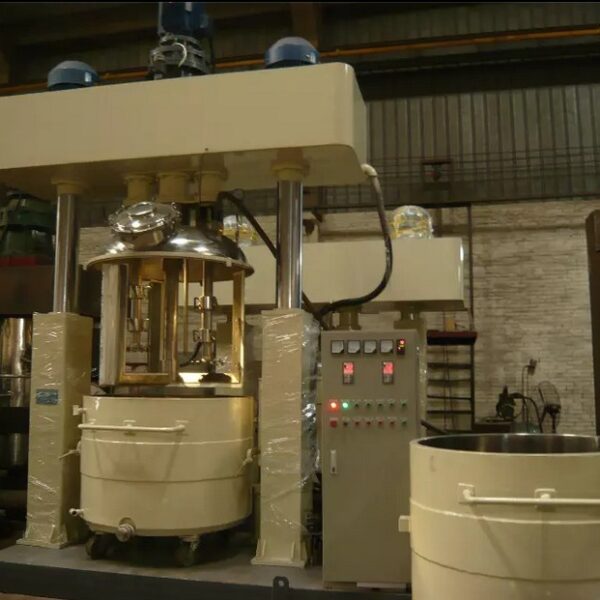 Triple Shaft Mixer | anchor type, butterfly type & frame type
Triple Shaft Mixer
Advantages of Triple Shaft mixer
- Long life with a sturdy mixing bowl made by a fully automatic welding robot
Can manufacture all kinds of concrete - High uniformity even with a short mixing time
Parts with excellent durability and wear resistance - Easy maintenance with replaceable bolt lining for large maintenance doors
Automatic lubrication system - Compact design and universal compatibility with existing concrete plants
Application: Paint, Adhesive, Battery, Pharmaceutical industry, Cosmetic
The triple shaft mixer extends the working area by adding a rotating stator mixer with a large displacement or a second quick distributor. High shear stator and rotary mixer can emulsify and homogenize products that require higher shear forces to reduce particles into smaller sizes.
Different materials have different functions that include; anchor type, butterfly type, and frame type. Driven by a power unit, it turns the rudder in a fixed direction. In the process of rotation, the material rotates axially and radially. The material in the mixer moves axially and circularly at the same time.
Therefore, there are various forms of agitation that include; shear agitation and diffusion agitation. The diffusion disc rotates at high speed, causing the material to flow in a ring, creating a strong vortex. Turn to the bottom of the vortex. Strong shear, impact, and friction occur between the particles, achieving rapid dispersion and dissolution functions. The stirrer plate moves in a circular motion, generating good radial forces and accelerating the material. Based on this, let’s discuss the detailed aspects of the triple shaft mixer.
What makes the triple shaft mixer unique?
● High-speed circulation to improve distribution efficiency
The mixer has precision technology for emulsification heads, advanced rotor, and stator adjustments. A powerful motor spins at high speed, creating a vacuum between the rotor and the stator. The materials are filled to the top of the rotor and stator.
High shear speed
Due to the high kinetic energy, the rotor achieves very high linear velocities, and the material is blown off after strong impact, crushing, centrifugation, the friction of the liquid layer, and high shift between the rotor and stator gaps. The high shear speed enhances more material mixing.
Triple shaft mixer specifications
Mixing the arm and blade with the two shafts is very difficult to maintain and replace. The mixer has unique wear-resistant centers and sieving blades made of Ultra Tungsten designated to address specific operational issues. The cast steel arm is designated to last longer in this harsh environment. Strong turbulence occurs under the action of forces in various directions. The material is subjected to repeated cycles of polymerization, dispersion, homogenization, purification, and shaving to produce a stable emulsion after some time under the appropriate amount of emulsifier and mature technique. The elevator’s hydraulic triple shaft mixer drives the hydraulic piston up and down by the operation of the hydraulic pump. The hydraulic pump rotates the entire transmission mechanism and working group up and down.
How does the triple shaft mixer work?
The mixer has a centrally mounted low-speed anchor spring or spiral blade that fights against the walls of the mixing bowl and two additional high-speed shafts. High-speed blades usually provide high shear forces to disperse or dissolve components. The low-speed rotor feeds the high-speed blade, which mixes the dough and folds into a container, and improves product uniformity by rubbing the walls. The mixers are used to mix medium to high viscosity materials. High-speed distributors require low-speed blades to obtain a uniform mixture, as they have a limited number of zones that affect viscous products. If equipped with a scraper, slow rotors also help with heat transfer.
For highly viscous materials, the mixers with different mixing elements are used for specific functions. Some designs are equipped with anchor impellers to move materials near the mixing vessel and high speed, high slip impellers that provide a high cutting action. Others can be equipped with spirals or worm screws, as well as anchors and stirrers. Depending on the application, these mixers are covered for heating or cooling. The mixer can be designed to operate in a high vacuum. Depending on the viscosity of the final mixture and the degassing method of the product, the mixer can be made with a structured surface or a solid surface. An interchangeable mixer with a device for lifting the mixing head and removing the mixing element from the mixing bowl is provided for stirring the mixing bowl after mixing. For highly viscous materials, a special hydraulic cylinder is required to remove the material from the mixing bowl.
FAQs of Triple Shaft Mixer:
Q: What is the material used for the Triple Shaft Mixer?
A: The Triple Shaft Mixer is made of industrial-grade stainless steel alloy.
Q: Is the mixer computerized?
A: No, the Triple Shaft Mixer is not computerized.
Q: What is the voltage requirement for the mixer?
A: The mixer requires a voltage of 415Volt (v).
Q: What is the general use of the Triple Shaft Mixer?
A: The Triple Shaft Mixer is designed for industrial use.
Q: Does the mixer feature any special technology?
A: Yes, the Triple Shaft Mixer features a frequency speed control system for precise mixing control.
Related Products:
High speed disperser