

Basket Type Strainer
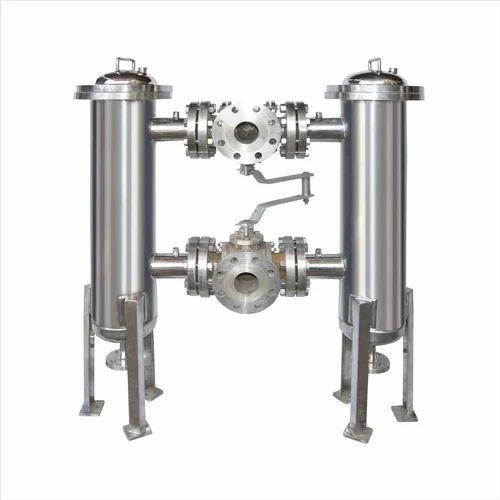
Bolted Cover Design, Basket Strainer Manufacturer
Easy Removable filtering element Basket Strainer Manufacturers
Screen Available from 2 mesh to 800 mesh (up to 5 microns)
Fabricated Basket Strainer as per ASME VIII Manufacturer
Higher Flow Area Basket Strainer on request Manufacturers
Special on demand :
Rubber Lined Basket Type Strainer
PTFE Lined Basket Type Strainer
Jacketed Basket Type Strainer
Tailor Made Basket Type Strainer Manufacturer & Exporters
.
What is Basket Strainer?
An official definition adopted by the Fluid Controls Institute is : “A closed vessel with cleanable screen element designed to remove and retain foreign particles down to 0.001 inch diameter from various flowing fluids.” Note the term “foreign particles”. Strainers do not necessarily remove only dirt. They take out material which is not wanted in the fluid and this can sometime be a valuable product which may be saved.
Basket Strainer designed for remove foreign matter from pipe lines and provides protection for pumps, meters, valves, and other similar mechanical equipment, which is called as Strainer. Basket Strainers feature top removal of the screen. The screen is in the form of a basket, with a lifting handle, so that all particulate captured and retained by the screen can be easily removed for disposal. The particulate matter is captured in the strainer basket. The line is then temporarily shut down and the basket removed for cleaning or replacement. Baskets are fabricated from stainless perforated sheet. The Basket Strainer is also called as Pot Strainer. The strainer improves the clearance in the medium, and prolongs the life of valves; protect expensive pumps, meters and other equipments. It is suitable for water, Air, Gas, petroleum, steam and other fluids.
Abster manufacturer & exporter of wide range of Industrial Strainer such as Basket Type Strainer, Bucket filter Strainer, “Y” Type Strainer, Pot Type Strainer, “T” Type Strainer, Magnetic Type Y Strainer, Conical Strainer, Simplex Strainer, Inline Strainer, Basket Strainer, Duplex Basket Strainer, pressure nutch filter etc.
____________________________________________________________________________________________________________
The Difference between Strainer & Filter
Actually there isn’t any since a strainer is, in reality, a coarse filter. The question is then one of semantics. Generally it is assumed that if the particle to be removed is not visible to the naked eye, the unit is filtering, and if the particle is visible, the unit is straining. The average human eye can detect a specific particle between 50 and 70 micros. Most people cannot see anything smaller than 325 mesh, or 44 microns. Since 200 mesh is equivalent to 74 microns, a general rule would be that if the screening device is coarser than 200 mesh, it is a strainer and if it is finer than 200 mesh it is a filter.
One of the best uses for a strainer is in conjunction with a filter. By installing a strainer directly ahead of a filter, the large heavy pieces which would quickly clog the filter are removed. The filter is then free to do its major job of fine particle removal and does not have to be cleaned so often
____________________________________________________________________________________________________________
What is Strainer Open Area Ratio & Important
Amount of free open area is the ratio of the open area through the strainer basket to the cross sectional area of the pipe. A common term used in strainer design is “Open Area Ratio” (OAR) equals the total open basket area divided by the internal cross-sectional area of the inlet pipe. It is a measure of relative debris-holding capacity and is usually between 1 to 4 times the inlet pipe area.
The open area ratio in strainer element refers to the amount of free open of the strainer and basket element. It is the ratio of the open area through the strainer basket to the cross sectional area of the pipeline. Anything less may cause excessive pressure drop. The ratio is calculated with a clean basket and as the basket begins to clog the ratio will drop. Unless there is a wide safety margin the area through the basket may quickly become smaller than the pipe area. This will reduce flow through the strainer and necessitate very frequent cleaning. A small open area ratio also means the holding capacity of the basket is small – an important consideration if the amount of solid matter to be removed is large.
Open Area Ratio = Total Basket Element Open Area / Inlet Pipe Cross Sectional Area (in. squared)
To determine the anticipated maximum differential pressure (DP), it is common to request the DP at 75% blockage. At 75% blockage, there is a 75% reduction in flow area compared to clean, and a DP equal to approximately 4X that of the clean DP Value. This is based on a proportional analysis with open basket area being inversely proportional to DP.
____________________________________________________________________________________________________________
How to select right Strainer Element?
The strainer element (it can be for y type strainer for basket type strainer) is the heart of a strainer since this is where the unwanted material is trapped. Strainer baskets elements are made of perforated sheet metal and a wide range of opening sizes is available. The size of the basket perforation should be slightly smaller than the minimum particle size to be removed. Using a smaller perforation opening than necessary only means the basket will fill and clog more quickly and have to be cleaned more often. By the using of fine element mesh sheet along with peforated sheet can achive fine filtration up to 5 Micron.
____________________________________________________________________________________________________________
When to Clean Basket Strainer Element?
Strainer basket element should be cleaned on a regular basis, not when they become clogged, to insure that they are not damaged by too high a differential pressure. One more reason for frequent cleaning is a phenomenon known as “runaway buildup”. As dirt in a strainer basket accumulates and as the mesh or perforations plug up, pressure drop increases. The curve of this pressure difference is not a straight line. It starts out as a low slope, but as the basket clogs more and more it turns upward faster and faster. As the dirt builds up the free open area in the basket gets smaller and smaller.
____________________________________________________________________________________________________________
Basket strainers remove damage causing particulate matter from the process media, protecting system components such as flow meters, pumps, mechanical seals and spray nozzles.
Basket Strainers feature top removal of the screen. The screen is in the form of a basket, with a lifting handle, so that all particulate captured and retained by the screen can be easily removed for disposal. The particulate matter is captured in the strainer basket. The line is then temporarily shut down and the basket removed for cleaning or replacement.
Advanced dynamic flow path and large filtration area elements ensure low pressure drops and reduced maintenance periods.
These strainers reduce downtime for cleaning due to their construction of bolted cover and easy removal of screen. They are ideal for very fine straining. We also manufactue and exporting of Duplex Type Basket Strainer with 3 Way Ball Valve and Butterfly Valve as per your client requirement. We design all fabircated basket strainer as per ASME Sec VIII. Our Basket Type Strainer is suitable for Water, Oil Gas, Air, Steam, Chemical, Petrochemical, Agro Chemical, Process Media. Our manufacturing range covers Steam or Hot Oil Jacketed Basket Type Strainer suitable for Lactum, Coltar, Sulphur, Bitumen, Asphalt, Sulphur, Wax etc. Our Y Type and Basket Type Strainer authorised dealer, distribitor and stockiest are in Kuwait, Muscat – Oman, Jebel Ali, Dubai, Sharjah – United Arab Emirates, Jeddah, Jubail Industrial City, Al-Khoabar, Dammam – Kingdom of Saudi Arabia, Bahrain, Egypt, Malaysia, Philippines, Singapore, Kenya, Africa etc.
Simplex
Basket Strainer
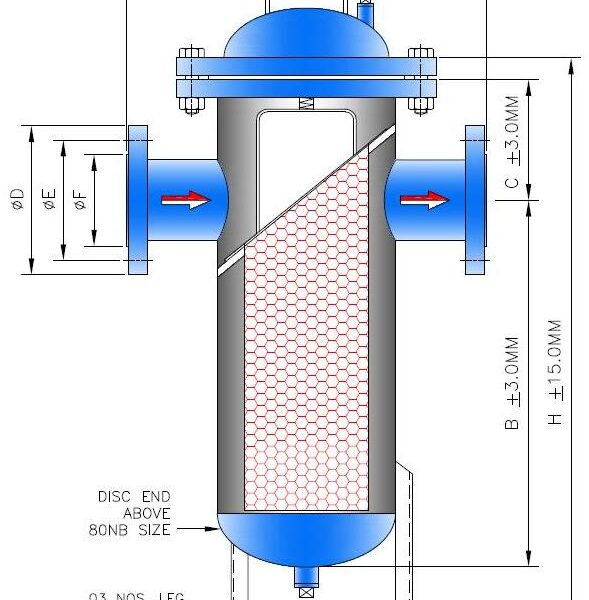
Dimensions – Basket Type Strainer Dimensions (Class
150 / PN6 / PN10 / PN16 / PN 25)
Flange
Drilling & Dimensions – As Per ANSI B 16.5, Class 150
(Other Standrad Drilling Available on Request)
| Size (INCH) |
1-1/2″ | 2″ | 2-1/2″ | 3″ | 4″ | 5″ | 6″ | 8″ | 10″ | 12″ |
| Size (DN) |
40 | 50 | 65 | 80 | 100 | 125 | 150 | 200 | 250 | 300 |
| F to F – A |
300 | 310 | 350 | 410 | 460 | 470 | 520 | 610 | 720 | 800 |
| C to Bottom – B |
220 | 240 | 300 | 350 | 380 | 460 | 550 | 710 | 860 | 870 |
| Cen. to Top – C |
100 | 100 | 120 | 130 | 160 | 170 | 190 | 230 | 260 | 310 |
| Height – H |
330 | 360 | 450 | 510 | 570 | 660 | 780 | 1230 | 1390 | 1480 |
| Flange O.D. – ØD |
127 | 152.4 | 177.8 | 190.5 | 228.6 | 254 | 279 | 343 | 406 | 483 |
| Flange PCD – ØE |
98.4 | 120.6 | 139.7 | 152.4 | 190.5 | 215.9 | 241.3 | 298.4 | 362 | 431.8 |
| R.F. Dia. – ØF |
73 | 92.1 | 104.7 | 127 | 157.2 | 185.6 | 215.9 | 269.9 | 323.8 | 381 |
| No. of Hole |
04 | 04 | 04 | 04 | 08 | 08 | 08 | 08 | 12 | 12 |
| Hole Dia. |
15.8 | 15.8 | 19 | 19 | 19 | 19 | 22.2 | 22.2 | 25.4 | 25.4 |
| *** Above Dimensions are subject to our Standard Manufacturing Range. Dimension may change subject to Flow Capacity, Pressure Rating and Open Area Ratio.*** Contact Factory for more Size & Pressure Rating Basket Strainer Dimensions. |
||||||||||
MESH TO MICRON CONVERSION
CHART
| U.S. MESH |
INCHES | MICRONS | MILIMETERS |
| 3 | 0.2650 | 6730 | 6.730 |
| 4 | 0.1870 | 4760 | 4.760 |
| 5 | 0.1570 | 4000 | 4.000 |
| 6 | 0.1320 | 3360 | 3.360 |
| 7 | 0.1110 | 2830 | 2.830 |
| 8 | 0.0937 | 2380 | 2.380 |
| 10 | 0.0787 | 2000 | 2.000 |
| 12 | 0.0661 | 1680 | 1.680 |
| 14 | 0.0555 | 1410 | 1.410 |
| 16 | 0.0469 | 1190 | 1.190 |
| 18 | 0.0394 | 1000 | 1.000 |
| 20 | 0.0331 | 841 | 0.841 |
| 25 | 0.0280 | 707 | 0.707 |
| 30 | 0.0232 | 595 | 0.595 |
| 35 | 0.0197 | 500 | 0.500 |
| 40 | 0.0165 | 400 | 0.400 |
| 45 | 0.0138 | 354 | 0.354 |
| 50 | 0.0117 | 297 | 0.297 |
| 60 | 0.0098 | 250 | 0.250 |
| 70 | 0.0083 | 210 | 0.210 |
| 80 | 0.0070 | 177 | 0.177 |
| 100 | 0.0059 | 149 | 0.149 |
| 120 | 0.0049 | 125 | 0.125 |
| 140 | 0.0041 | 105 | 0.105 |
| 170 | 0.0035 | 88 | 0.088 |
| 200 | 0.0029 | 74 | 0.074 |
| 230 | 0.0024 | 63 | 0.063 |
| 270 | 0.0021 | 53 | 0.053 |
| 325 | 0.0017 | 44 | 0.044 |
| 400 | 0.0015 | 37 | 0.037 |
Strainer
Mesh
Sizes and Microns
Strainer
– What does mesh size
mean? Figuring out mesh sizes is simple. All you do is count the number of openings in one inch of
screen (in the
United States
, anyway.) The number of
openings is the mesh size. So
a 4-mesh screen means there are four little squares across one
linear inch of screen. A
100-mesh screen has 100 openings, and so on. As the number describing the mesh size increases, the size of
the particles decreases. Higher
numbers equal finer material. Mesh
size is not a precise measurement of particle size.
Strainer
– What do the minus (-)
and plus (+) plus signs mean when describing mesh sizes?
Here’s a simple example of how they work. –200-mesh would mean that all particles smaller than
200-mesh would pass through. +200 mesh means that all the particles
200-mesh or larger are retained.
Strainer
– How fine do screens
get? That depends on the wire thickness.
If you think about it, the finer the weave, the closer the
wires get together, eventually leaving no space between them at all.
For this reason, beyond 325-mesh particle size is usually described
in “microns.”
Strainer
– What is a micron? A micron is another measurement of particle size.
A micron is one-millionth of a meter or one twenty-five
thousandth of an inch.
Basket
Strainer Basket
Construction :
Baskets are fabricated from stainless perforated sheet. The relevant degree of filtration is provided by welding the appropriate grade of Stainless Steel mesh to the basket
 |
|

|
|
|
|
|
|
|
|
|
|